Tech Burner's Anarc Smartwatch: Why India's Hyped Gadget Flopped Hard
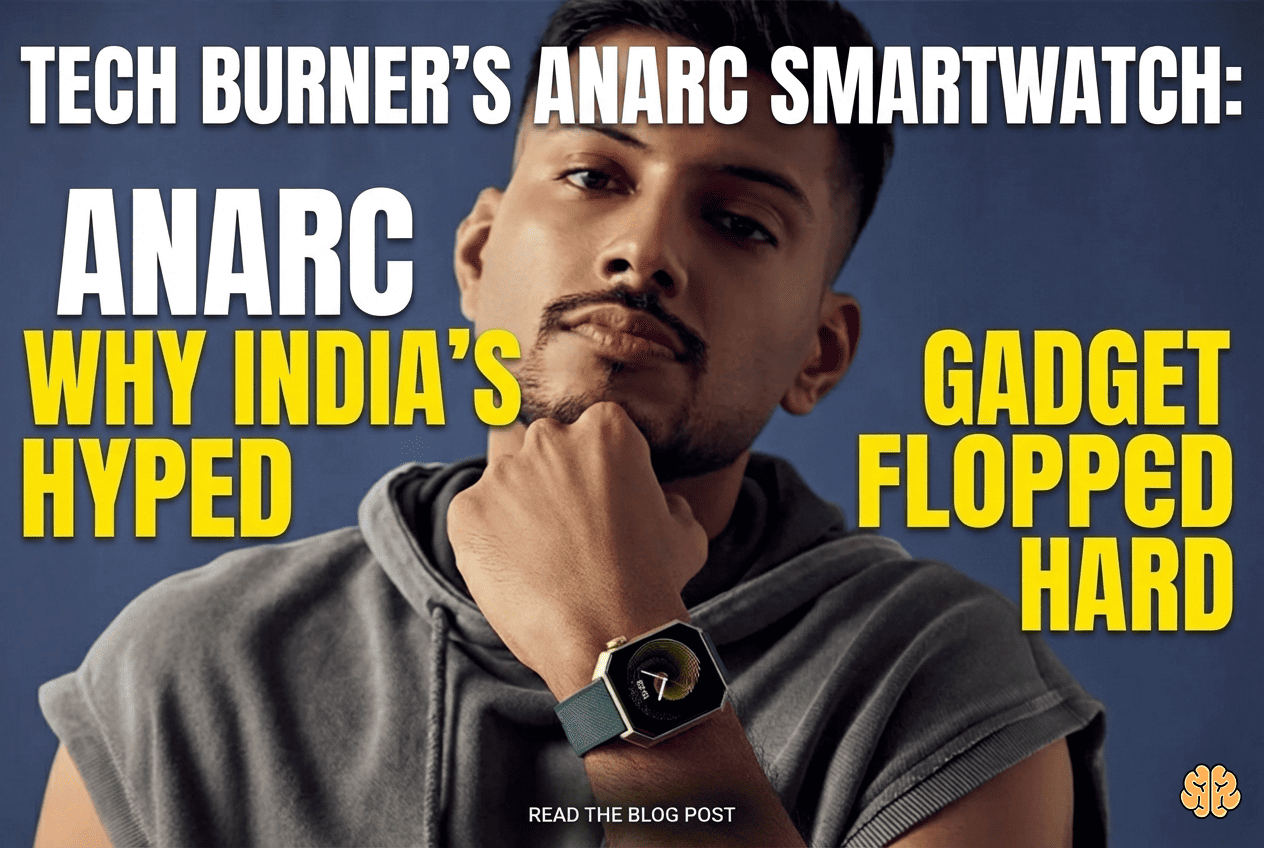
Let me tell you about one of the most spectacular product flops in Indian tech history.
Tech Burner—Shlok Srivastava to his parents—built a massive YouTube following (10+ million subscribers) reviewing gadgets, roasting overpriced tech, and calling out companies for misleading claims.
Then he decided to launch his own smartwatch brand called Anarc.
The irony? He became everything he criticized.
The Anarc smartwatch launched with enormous hype, celebrity endorsements, and bold promises. Within months, it became a case study in how NOT to launch a product—plagued by delays, quality issues, customer service nightmares, and a community backlash so severe it damaged Tech Burner's credibility.
Let me break down exactly what went wrong, why it matters, and what lessons emerge from this train wreck.
Who Is Tech Burner and Why Did People Trust Him?
Before we dissect the failure, let's understand why Anarc had potential in the first place.
Shlok Srivastava (Tech Burner) built his YouTube empire on authenticity and brutal honesty. He:
- Called out smartphone companies for misleading marketing
- Exposed overpriced accessories and knockoffs
- Reviewed products without pulling punches
- Built a reputation as "the guy who tells the truth"
His audience trusted him. When he criticized a product, people believed him. When he recommended something, they bought it.
So when Tech Burner announced his own smartwatch brand, fans were excited. Finally, a smartwatch designed by someone who understood what consumers actually wanted, free from corporate BS.
Spoiler alert: That's not what happened.
The Anarc Promise: What Was Supposed to Happen
The Anarc smartwatch launched with big claims:
The pitch:
- "India's first premium affordable smartwatch"
- Superior build quality compared to competitors
- Advanced health tracking features
- Stunning AMOLED display
- Long battery life (7+ days claimed)
- Seamless user experience
- Designed by someone who actually uses smartwatches
The pricing: ₹2,999-₹3,999 (approximately $35-$50 USD), positioning it as a premium budget option.
The target audience: Tech Burner's young, tech-savvy followers who wanted quality without breaking the bank.
The marketing: Heavy YouTube promotion, Instagram campaigns, influencer partnerships, and Tech Burner's personal endorsement.
Early reception: Pre-orders flooded in. People were hyped. The comment sections were full of "finally, an honest product" and "taking Indian tech forward."
Then reality hit. Hard.
The Problems: Where Everything Went Wrong
Problem 1: Delivery Delays (The First Red Flag)
Promised delivery: 15-20 days after order
Actual delivery: Months for many customers
People who pre-ordered in the initial launch waited 2-3 months for their watches. Some waited even longer.
The excuses kept changing:
- "Supply chain issues"
- "Quality control delays"
- "Logistics problems"
- "High demand overwhelming production"
Customer frustration mounted. When you're competing with Amazon's same-day delivery culture, making people wait months for a ₹3,000 watch is brutal.
The bigger issue: Poor communication. Customers didn't get regular updates. Support was unresponsive. People felt ghosted.
Problem 2: Quality Control Disasters
When watches finally arrived, the problems multiplied:
Build quality issues:
- Cheap-feeling materials despite "premium" claims
- Loose buttons and crowns
- Screen bezels separating from the body
- Straps breaking within days
- Inconsistent build quality (some units fine, others terrible)
Software bugs:
- Laggy interface
- Features not working as advertised
- Frequent crashes and freezes
- Inaccurate health tracking (step counts wildly off)
- Battery draining faster than claimed
Display problems:
- Dead pixels on AMOLED screens
- Uneven brightness
- Touch sensitivity issues
- Screen protector bubbling
The realization hit: These weren't isolated defects. Quality control was fundamentally broken.
Problem 3: Customer Service Nightmare
When customers reported problems, the real horror began:
Support issues:
- Unresponsive customer service emails
- WhatsApp support that ghosted people
- Replacement/refund requests ignored
- Weeks to get responses, if at all
- No phone support available
Return/exchange chaos:
- Complicated return processes
- Refunds delayed for months
- Customers told to ship defective units at their own cost
- Some returns allegedly "lost in transit"
Social media complaints exploded. Instagram comments, YouTube videos, Twitter threads—angry customers everywhere.
Tech Burner's response: Initially defensive, then silent, eventually apologetic but with little concrete action.
Problem 4: The Rebranding Scandal
Here's where it got really messy.
Allegations emerged that Anarc was essentially a rebranded Chinese smartwatch with minimal customization and Tech Burner's branding slapped on.
The evidence:
- Identical designs to existing Chinese models
- Similar specifications to generic smartwatches
- Manufacturing likely outsourced with minimal oversight
- Software interface nearly identical to competitor models
The accusation: Tech Burner criticized other brands for doing exactly this (rebranding Chinese products), then did it himself.
The hypocrisy burned. Fans who trusted him felt betrayed.
Tech Burner's defense: Claimed significant customization and quality improvements over base models. But customers' experiences contradicted this.
Problem 5: Misleading Marketing
Claims vs. Reality:
Claim: "7+ days battery life"
Reality: 2-4 days for most users, sometimes less
Claim: "Premium build quality"
Reality: Felt cheap, broke easily
Claim: "Advanced health tracking"
Reality: Inaccurate readings, basic functionality
Claim: "Designed for Indian users"
Reality: Generic features available on countless other watches
The frustration: People bought based on Tech Burner's reputation for honesty. The marketing felt like every misleading campaign he'd criticized.
Problem 6: Competition Was Better
At the same or lower price points, established brands offered better options:
- Noise smartwatches: Better quality control, reliable service
- boAt smartwatches: Wider availability, proven track record
- Amazfit: Superior build quality, better software
- Realme Watch: Similar features, more reliable
Even Xiaomi's Mi Band at half the price offered better value for basic features.
Anarc's differentiation evaporated. Without superior quality, the only selling point was Tech Burner's name—and that was becoming a liability.
The Community Backlash: Trust Destroyed
The Indian tech community turned on Tech Burner viciously.
YouTube Comments Revolt
His video comment sections became war zones:
- "You became the very thing you swore to destroy"
- "Lost all respect"
- "Sellout"
- "Hypocrite calling out others then doing worse"
- "Where's my refund?"
Even positive content about other products got flooded with Anarc complaints.
Competitor YouTubers Pounced
Other tech YouTubers made videos exposing Anarc's issues:
- Comparison videos showing better alternatives
- Customer complaint compilations
- Teardown videos revealing cheap internals
- Analyses of the rebranding allegations
The "roaster got roasted" narrative became a content goldmine for competitors.
Social Media Pile-On
Twitter, Instagram, Reddit—everywhere the sentiment was similar:
"Tech Burner lost credibility"
Memes flooded the internet. His past videos criticizing other brands were clipped and contrasted with Anarc's problems.
The trust erosion was devastating. Once credibility is lost in the tech space, it's nearly impossible to fully recover.
Why Did This Happen? The Root Causes
Let's analyze what actually went wrong beyond surface-level problems.
Lack of Manufacturing Experience
Building a following ≠ building a product company.
Tech Burner understood content creation, marketing, and audience engagement. But product development, supply chain management, quality control, and customer service? Completely different skill sets.
He likely underestimated the complexity of hardware manufacturing and overestimated his ability to "disrupt" the market.
Outsourcing Without Oversight
Partnering with Chinese manufacturers isn't inherently wrong. Most brands do it. But it requires rigorous quality control, regular audits, and leverage to enforce standards.
Tech Burner probably lacked that leverage. Small orders, new relationship, minimal bargaining power—recipe for manufacturers cutting corners.
Overpromising in Marketing
The hype machine ran too hot. Claims exceeded what the product could deliver, likely because:
- Competitive pressure to stand out
- Overconfidence in the product
- Prioritizing sales over realistic expectations
Influencer marketing curse: When your personal brand is the product's credibility, failures hurt exponentially more.
Inadequate Capital and Infrastructure
Building a hardware brand requires significant investment:
- Inventory management
- Warehouse infrastructure
- Customer service teams
- Quality assurance processes
- Logistics partnerships
Anarc likely launched undercapitalized, trying to bootstrap with pre-order money. When problems arose, they lacked resources to solve them quickly.
Wrong Business Model
Tech Burner should have partnered with an established brand rather than launching independently. Collaborate on design and marketing while letting experienced companies handle manufacturing, distribution, and support.
Going fully independent was hubris, underestimating how difficult hardware businesses are.
The Damage: What Tech Burner Lost
Credibility Erosion
His entire brand was built on calling out BS. Anarc's problems made him look like a hypocrite.
Future product reviews are now suspect. When he criticizes a competitor's smartwatch, comments will say "but Anarc was worse."
Trust is fragile. Years building it, months destroying it.
Financial Losses
Exact figures aren't public, but consider:
- Manufacturing costs for defective units
- Refunds and replacements
- Customer service costs
- Marketing spend with negative ROI
- Legal exposure from angry customers
Probably millions of rupees lost, possibly more.
Community Relationships
Fans felt betrayed. Some forgave him, many didn't. His subscriber growth slowed. Engagement dropped.
Brand partnerships became riskier. Companies might hesitate to work with someone associated with a failed product launch.
Mental/Emotional Toll
Public failure is brutal, especially when your face is the brand. The stress, criticism, and reputational damage take psychological tolls.
What Happened Next: The Aftermath
Tech Burner eventually addressed the situation:
- Posted apology videos acknowledging problems
- Committed to improving customer service
- Offered refunds to unsatisfied customers
- Claimed to be working on quality improvements
But the damage was done.
Current status of Anarc: Still selling, but with minimal marketing presence. Sales likely dropped significantly. Community enthusiasm evaporated.
Tech Burner's channel: Continues, but he's more careful now. Less criticism of other brands (glass houses and all). More neutral reviews.
The lesson learned: Stick to what you're good at, or partner with those who complement your weaknesses.
Lessons for Influencers and Entrepreneurs
1. Credibility Is Your Only Asset
As an influencer-entrepreneur, trust is everything. One failed product can destroy years of audience building.
Protect your credibility more carefully than you chase profits.
2. Know What You Don't Know
Expertise in one area doesn't transfer to another. Great content creator ≠ great product developer.
Either learn deeply or partner wisely. Half-measures create disasters.
3. Start Small, Test Thoroughly
Don't launch with massive hype and pre-orders. Start with limited releases, gather feedback, fix problems, then scale.
Tech products especially need beta testing. Real-world usage reveals issues labs miss.
4. Customer Service Is Non-Negotiable
Bad products with great service survive. Great products with bad service fail.
Invest in support infrastructure before launching. It's not glamorous, but it's essential.
5. Be Honest About Limitations
If there are delays, communicate clearly. If there are defects, own them quickly. If you're learning, admit it.
Transparency builds trust. Silence destroys it.
The Bottom Line: A Cautionary Tale
The Anarc smartwatch flopped because ambition exceeded capability.
Tech Burner had audience, hype, and good intentions. What he lacked was:
- Manufacturing expertise
- Quality control systems
- Adequate capital
- Realistic timelines
- Proper customer service infrastructure
The result: Delayed deliveries, quality problems, customer service failures, and a reputation in tatters.
Is Tech Burner finished? No. He still has millions of followers. He can rebuild. But it'll take time, humility, and consistency.
Is Anarc finished? Probably not entirely, but it'll never achieve the potential it had at launch.
The real lesson: Building great content and building great products require different skills. Confuse the two at your peril.
For Indian consumers, Anarc serves as a reminder: Don't buy based on influencer hype alone. Wait for reviews, check quality, verify claims.
For influencers, Anarc is a warning: Your credibility is precious and fragile. Don't gamble it on ventures you're not prepared to execute flawlessly.
Tech Burner became what he criticized. And in tech, that's the ultimate flop.
