Wired vs Wireless Chargers: Which Is Better & Faster?
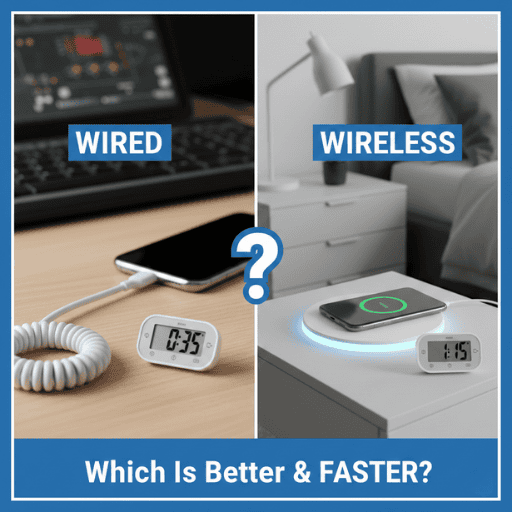
You're late for a meeting and your phone's at 12%. You have exactly 15 minutes. Do you grab the wireless charging pad on your desk or scramble for a cable? That split-second decision reveals a fundamental truth about modern charging technology: convenience and speed are often in conflict.
Wireless charging represents the future we were promised—just drop your phone on a pad and walk away. No fumbling with cables in the dark, no worn-out charging ports, no drawer full of tangled cords. But wired charging remains stubbornly superior in the metric that matters most when you're in a hurry: raw speed.
The debate isn't academic. Your charging choice affects how you use your phone, how long your battery lasts, and whether you'll make it through the day without anxiety. Marketing materials promise "fast wireless charging" and "cable-free convenience," but the reality is more nuanced than slogans suggest.
Let's examine wired and wireless charging honestly—the physics that dictate performance, the real-world speed differences, the hidden costs, and which you should actually use based on how you live, not how manufacturers wish you lived.
The Physics: Why Wireless Will Always Be Slower
Understanding the speed gap requires understanding how each technology works.
Wired Charging: Direct Electrical Transfer
When you plug a cable into your phone, electricity flows directly from the charger, through the cable, into the phone's charging circuitry, and finally to the battery. The path is direct, efficient, and controlled.
Energy loss: Minimal—modern cables and chargers achieve 85-95% efficiency. Most energy reaches the battery.
Heat generation: Moderate—concentrated in the phone's charging circuitry and battery, which are designed to dissipate heat effectively.
Power delivery: Can scale dramatically—from 5W (old USB chargers) to 240W+ (USB Power Delivery 3.1 standard). Modern fast charging delivers 25W-120W depending on phone and charger.
Wireless Charging: Electromagnetic Induction
Wireless charging uses electromagnetic induction—the charging pad contains a coil that generates an electromagnetic field. Your phone has a receiving coil that converts this field back into electricity. No physical connection needed, but physics imposes costs.
The process:
- Charger converts AC power to electromagnetic field
- Field transmits through air gap between charger and phone
- Phone's receiving coil captures field and converts to DC power
- Charging circuitry routes power to battery
Energy loss: Significant—30-50% of energy is lost in the conversion and transmission process. Wireless charging achieves only 50-70% efficiency.
Where the energy goes: Heat. That lost 30-50% becomes heat in both the charging pad and phone, which must be dissipated to prevent damage.
Power delivery limits: Physics limits wireless power transfer. Current Qi standard maxes at 15W (iPhone), with some proprietary systems reaching 30-50W. But efficiency losses mean even "30W wireless" delivers less actual power to battery than "30W wired."
The Fundamental Truth:
Wireless charging will always be less efficient than wired because it adds conversion steps and air gap transmission. Each step loses energy. This isn't a limitation of current technology—it's physics.
Speed Comparison: The Numbers Don't Lie
Let's compare real-world charging speeds using common scenarios:
Budget/Standard Charging (₹500-1,500 chargers)
Wired:
- 5W (old USB): 0-50% in 90-120 minutes, 0-100% in 3-4 hours
- 10W (basic USB-C): 0-50% in 60 minutes, 0-100% in 2-2.5 hours
- 20W (modern standard): 0-50% in 30-40 minutes, 0-100% in 90-120 minutes
Wireless:
- 5W (basic Qi): 0-50% in 100-140 minutes, 0-100% in 3.5-5 hours
- 7.5W (iPhone standard): 0-50% in 80-110 minutes, 0-100% in 3-4 hours
- 10W (Android standard): 0-50% in 70-100 minutes, 0-100% in 2.5-3.5 hours
Winner: Wired by significant margin—typically 30-50% faster.
Fast Charging (₹2,000-5,000 chargers)
Wired:
- 25W (Samsung): 0-50% in 25-30 minutes, 0-100% in 70-90 minutes
- 30W (OnePlus, Xiaomi): 0-50% in 20-25 minutes, 0-100% in 60-75 minutes
- 45W (Samsung Ultra): 0-50% in 18-22 minutes, 0-100% in 55-70 minutes
- 65W+ (OnePlus, Xiaomi): 0-50% in 12-18 minutes, 0-100% in 35-50 minutes
Wireless:
- 15W (Apple MagSafe): 0-50% in 50-70 minutes, 0-100% in 2-2.5 hours
- 15W (Samsung): 0-50% in 45-60 minutes, 0-100% in 2-3 hours
- 30W (OnePlus proprietary): 0-50% in 35-50 minutes, 0-100% in 90-120 minutes
Winner: Wired by massive margin—2-3x faster in many cases.
Ultra-Fast Charging (₹3,000-8,000 chargers)
Wired:
- 100W (Xiaomi): 0-50% in 8-12 minutes, 0-100% in 25-35 minutes
- 120W (Xiaomi, OnePlus): 0-50% in 7-10 minutes, 0-100% in 20-30 minutes
- 150W+ (Realme, OnePlus): 0-50% in 5-8 minutes, 0-100% in 15-25 minutes
Wireless:
- 50W (Xiaomi, OnePlus proprietary): 0-50% in 25-35 minutes, 0-100% in 60-80 minutes
- 80W (Xiaomi): 0-50% in 18-25 minutes, 0-100% in 45-60 minutes
Winner: Wired still dominates—even "fast wireless" can't match mid-tier wired speeds.
The 15-Minute Emergency Charge Scenario
You have 15 minutes to charge before leaving. How much battery do you get?
Wired:
- 20W standard: 25-35%
- 45W fast: 40-50%
- 100W ultra-fast: 60-80%
Wireless:
- 10W standard: 10-15%
- 15W "fast": 15-20%
- 30W proprietary: 20-30%
The Verdict: In emergency situations, wired charging provides 2-3x more charge in the same time.
Efficiency and Energy Waste
The environmental and economic costs of inefficiency:
Wired Charging Energy Loss:
A 20W wired charger operating at 90% efficiency wastes 2W during charging. If you charge daily for 2 hours, that's:
- 4Wh wasted per day
- 1.46 kWh wasted per year
- ₹15-20 annual energy cost (at ₹10/kWh)
- ~1.5 kg CO₂ emissions annually
Wireless Charging Energy Loss:
A 15W wireless charger operating at 60% efficiency requires 25W from the wall, wasting 10W. Same 2-hour daily charge:
- 20Wh wasted per day
- 7.3 kWh wasted per year
- ₹70-90 annual energy cost
- ~7.5 kg CO₂ emissions annually
The Hidden Cost:
Wireless charging costs 4-5x more in electricity and produces 5x the emissions for the same amount of battery charging. Individually small, but multiplied across billions of devices, it's significant.
Heat and Battery Degradation:
The energy lost as heat doesn't just waste electricity—it accelerates battery degradation.
Wired charging: Generates moderate heat, primarily in battery (unavoidable chemical process). Modern phones manage this with intelligent charging curves that slow down as battery fills.
Wireless charging: Generates heat in charging pad, phone's receiving coil, and battery. This triple heat source elevates phone temperature 5-10°C higher than wired charging.
Impact on battery lifespan:
Heat is the primary enemy of lithium-ion batteries. Every 10°C temperature increase approximately doubles the degradation rate.
Studies show:
- Wired charging: 80% capacity after ~500-800 charge cycles (2-3 years typical use)
- Wireless charging: 80% capacity after ~400-600 charge cycles (1.5-2.5 years typical use)
The Difference: Wireless charging may reduce battery lifespan by 20-30% due to increased heat exposure.
Convenience: Where Wireless Wins
Despite speed and efficiency disadvantages, wireless charging offers genuine convenience benefits:
1. No Cable Wear and Tear
USB-C cables fail. The connector bends, the cable frays near connectors, internal wires break. Typical cable lifespan: 6-18 months with daily use.
Wireless pads have no moving parts, no connectors to wear out. A quality wireless charger lasts 5-10 years.
Cost over 5 years:
- Wired: 3-8 replacement cables at ₹500-1,500 each = ₹1,500-12,000
- Wireless: One-time pad purchase = ₹1,500-4,000
2. No Port Wear
Phone charging ports accumulate lint, suffer connector wear, and eventually fail. Port replacement requires professional repair (₹2,000-5,000) or new phone.
Wireless charging eliminates port usage, extending port lifespan for data transfer and occasional wired charging needs.
3. Seamless Routine Integration
Walk into your office, drop phone on pad—charging automatically. Walk to bedside, drop phone on pad—charging automatically. No fumbling for cables in the dark, no conscious effort.
This "frictionless" charging encourages more frequent top-ups throughout the day, keeping battery levels higher.
4. MagSafe and Magnetic Alignment
Apple's MagSafe (and Android alternatives) solves wireless charging's biggest problem: alignment.
Standard wireless charging requires precise placement. Slight misalignment = no charging or inefficient charging. You return hours later to find phone didn't charge because it was 2cm off-center.
Magnetic alignment ensures perfect placement every time. The convenience benefit is real and significant.
5. Multi-Device Charging Pads
One pad charges phone + watch + earbuds simultaneously, replacing three separate chargers and eliminating cable clutter.
Desk/nightstand transformation:
- Before: Three cables, three power adapters, visual chaos
- After: One pad, one cable, clean aesthetic
Portability and Travel
Wired Wins Decisively:
Size and weight:
- Wired: Single USB-C cable weighs 20-30g, fits in any pocket
- Wireless: Charging pad weighs 100-200g, requires space in bag
Versatility:
- Wired: One cable charges phone, tablet, laptop, headphones, power bank
- Wireless: Only charges devices with wireless charging coils, and only one at a time (unless using expensive multi-device pad)
Power bank compatibility:
- Wired: All power banks support wired charging
- Wireless: Limited wireless power banks exist, they're expensive, inefficient, and slow
Hotel/airport use:
- Wired: Plug into any USB port or outlet with adapter
- Wireless: Requires bringing pad, limited surfaces suitable for placement
For travel: Wired charging is objectively superior—lighter, more versatile, faster, works everywhere.
The Case-by-Case Analysis
Wired Charging Is Better When:
✅ Speed matters: Emergency charging, quick top-ups, maximizing charge in limited time
✅ Traveling: Portability, versatility, and universal compatibility are essential
✅ Battery longevity priority: Minimizing heat to extend battery lifespan
✅ Energy efficiency matters: Lower electricity costs, reduced environmental impact
✅ Maximum power delivery needed: Charging tablets, laptops, or phones with ultra-fast wired charging
✅ Budget-conscious: Cheaper chargers deliver better performance
Wireless Charging Is Better When:
✅ Convenience over speed: Desk/bedside charging where phone sits for hours
✅ Protecting charging port: Reducing mechanical wear on frequently-used devices
✅ Aesthetic/minimal setup: Clean desk with no cable clutter
✅ Frequent pick-up/put-down usage: Office workers, frequent phone checkers benefit from effortless charging cycles
✅ Multiple devices: Charging phone + watch + earbuds simultaneously on one pad
✅ Using phone while charging: Some wireless stands allow easier viewing angles than propped phone with cable
✅ MagSafe accessories: If using MagSafe cases, wallets, or mounts, charging pad integrates into ecosystem
The Hybrid Approach: Best of Both Worlds
Most people benefit from strategic use of both:
Home/Office Wireless Charging:
Primary charging at desk and bedside uses wireless pads. Phone sits for hours, speed isn't critical, convenience maximizes.
Travel/Emergency Wired Charging:
Carry a quality USB-C cable and compact 30W+ charger for travel and emergency situations requiring fast charging.
The Optimal Setup:
- Bedside: Wireless charging stand (charges overnight, serves as alarm clock/display)
- Desk: Wireless charging pad (convenient top-ups during work)
- Car: MagSafe magnetic car mount with charging (navigation + charging)
- Bag/Pocket: USB-C cable + compact fast charger (emergency and travel)
- Power bank: Wired only (faster, more efficient)
Cost: ₹5,000-10,000 total
- 2x wireless pads: ₹2,000-4,000
- 1x car mount with charging: ₹1,500-3,000
- 1x quality cable: ₹500-1,000
- 1x fast charger: ₹1,000-2,000
Myths and Misconceptions
Myth 1: "Wireless charging damages batteries more than wired"
Reality: Both generate heat; wireless generates more. The heat, not the charging method itself, affects battery lifespan. Quality wireless chargers with thermal management minimize damage, though they still generate more heat than equivalent wired charging.
Myth 2: "You can't use your phone while wireless charging"
Reality: You can pick up the phone anytime—charging just stops. Charging stands allow viewing at angles while charging continues. But yes, actually holding and using the phone interrupts charging.
Myth 3: "Wireless charging is as fast as wired now"
Reality: Marketing obscures truth. "30W wireless" isn't equivalent to "30W wired" due to efficiency losses. Wireless has improved but remains significantly slower watt-for-watt.
Myth 4: "Overnight charging degrades batteries, so slow wireless is better"
Reality: Modern phones use intelligent charging management, slowing to trickle charge near 100% regardless of charger type. Overnight charging doesn't damage batteries like it did a decade ago. The speed difference is irrelevant for overnight charging—both reach 100% by morning.
Myth 5: "Cheap wireless chargers work just as well as expensive ones"
Reality: Quality varies dramatically. Cheap wireless chargers:
- Use weak magnets (MagSafe-style) or poor coil alignment
- Generate excess heat
- Charge inconsistently
- Lack safety certifications
- Can damage devices or start fires
Premium chargers justify costs through better thermals, reliable charging, and safety certifications.
Myth 6: "Wired charging ruins charging ports"
Reality: Ports are rated for thousands of insertion cycles. Normal use won't destroy them. Rough handling, lint accumulation, and liquid damage cause most port failures, not regular charging.
The Future: Where Charging Technology Is Heading
Long-Range Wireless Charging:
Companies are developing wireless charging that works across room distances (1-3 meters) without pads. Still limited to low power (1-5W) and facing efficiency challenges, but could revolutionize charging if physics can be overcome.
Higher-Power Wireless:
Proprietary standards reaching 100W+ wireless exist (Xiaomi, OnePlus) but require specific charger + phone combinations. Qi2 standard (MagSafe-compatible) may eventually support higher power universally.
USB-C Becoming Universal:
EU mandate requiring USB-C on all devices will standardize wired charging, making cable compatibility simpler. Even iPhones now use USB-C (iPhone 15+).
Battery Technology Improvements:
Solid-state and alternative battery chemistries may reduce heat sensitivity, mitigating wireless charging's battery degradation disadvantage.
Reverse Wireless Charging Expansion:
Phones wirelessly charging other devices (earbuds, watches, other phones) adds utility to wireless charging coils.
The Prediction:
Wireless and wired will coexist indefinitely. Physics prevents wireless from matching wired speed and efficiency, but convenience ensures wireless remains valuable for specific use cases. The future is hybrid—both technologies optimized for their strengths.
The Verdict: Which Should You Use?
The Honest Answer: Both, strategically.
Use wired when:
- You need speed (emergency charging, limited time)
- You're traveling (portability, versatility)
- Charging high-capacity devices (tablets, laptops)
- Energy efficiency matters to you
- You want to maximize battery lifespan
Use wireless when:
- Phone will sit charging for hours anyway (overnight, during work)
- Convenience outweighs speed (desk, bedside)
- You value aesthetic/minimal cable setups
- Port preservation matters (devices you plan to keep 4+ years)
- You're using MagSafe accessories ecosystem
Don't Choose One Exclusively:
The people happiest with their charging setups use wireless for convenience-focused stationary charging (desk, bedside, car) and wired for speed-focused mobile charging (travel, emergency, quick top-ups).
The Bottom Line:
Wireless charging is slower, less efficient, more expensive, and generates more heat than wired charging. These aren't temporary limitations—they're fundamental to the physics of inductive charging.
But wireless charging offers genuine convenience that matters in specific contexts. The ability to drop your phone on a pad without thinking, maintain a clean desk free of cable clutter, and reduce port wear has real value.
Neither is "better" universally. They're tools optimized for different priorities. Choose based on the specific situation, not ideology. Your phone doesn't care which you use—only that you use the right one for the right context.
Charge smartly, charge strategically, and let physics guide your decisions, not marketing.
