ANC Headphones Explained: How Noise Cancellation Really Works
You're on a plane, engines roaring. You put on your headphones, press a button, and suddenly... silence. The engine noise vanishes as if someone hit mute on the world. It feels like magic—almost unsettling in its effectiveness. How do those tiny headphones cancel out the massive sound of jet engines?
Or you're in a coffee shop, trying to focus. Conversations, espresso machines, chair scraping—all competing for your attention. You activate noise cancellation, and the chaos recedes to a distant murmur, leaving you in a bubble of focus.
This isn't magic—it's Active Noise Cancellation (ANC), one of the most impressive feats of consumer audio engineering. But how does it actually work? Why does it excel at canceling airplane engines but struggle with human voices? And what's the difference between the $50 ANC headphones and the $400 Sony or Bose flagships?
Let's dive deep into the science, technology, and practical reality of noise cancellation.
The Physics: Fighting Sound with Sound
To understand ANC, you need to understand sound itself.
Sound as Waves
Sound travels as waves through air—areas of compressed and rarefied air molecules creating pressure variations your eardrums detect. These waves have specific characteristics:
Frequency: How many times per second the wave cycles (measured in Hertz). Low frequencies = bass/rumble (airplane engines, traffic). High frequencies = treble/sharp sounds (voices, alarms).
Amplitude: The wave's height, corresponding to volume. Bigger amplitude = louder sound.
Phase: The wave's position in its cycle at any given moment. This is crucial for noise cancellation.
The Cancellation Principle
Active noise cancellation works through destructive interference—a principle of wave physics.
When two sound waves meet:
- If they're in phase (peaks align with peaks, troughs with troughs), they add together, creating louder sound
- If they're out of phase (peaks align with troughs), they cancel each other out, creating silence
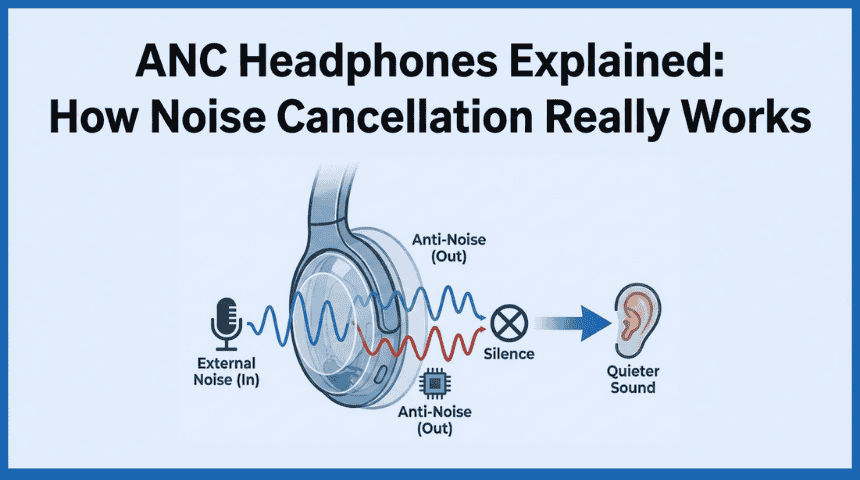
ANC headphones create an "anti-noise" wave—exactly matching incoming noise but inverted (180° out of phase). When the noise and anti-noise meet, they theoretically cancel perfectly, leaving silence.
Think of it like this: noise is a wave pushing your eardrum in. ANC generates an opposite wave pushing out. The two forces cancel, and your eardrum experiences neither—silence.
How ANC Headphones Actually Work
Understanding the principle is one thing. Implementing it in milliseconds, for constantly changing noise, in a tiny device, is remarkable engineering.
The Components
Every ANC headphone contains:
1. External microphones (feedforward): Mounted on the outside of ear cups, these capture environmental noise before it reaches your ear.
2. Internal microphones (feedback): Positioned inside the ear cup near your ear, these monitor what you actually hear, including any noise that leaked through.
3. Processing chip: The brain of the system, analyzing microphone input and generating anti-noise signals in real-time.
4. Speaker drivers: The headphone speakers that output both your music AND the anti-noise signal.
The Process (Happening in Milliseconds)
Step 1: External microphones detect incoming noise (airplane engine rumble, train noise, AC hum).
Step 2: The processing chip analyzes this noise—determining its frequency, amplitude, and phase.
Step 3: The chip generates an inverted waveform (anti-noise)—matching the incoming noise exactly but 180° out of phase.
Step 4: This anti-noise is sent to the speaker drivers within 1-2 milliseconds (crucial timing—any delay and the phase relationship breaks down).
Step 5: The anti-noise meets the real noise at your eardrum, canceling it out.
Step 6: Internal microphones monitor what you actually hear, feeding data back to the chip so it can adjust anti-noise in real-time for maximum cancellation.
This entire process happens continuously, thousands of times per second, adapting to constantly changing noise environments.
Why ANC Excels at Some Sounds and Struggles with Others
You've probably noticed: ANC brilliantly eliminates airplane engines but barely touches conversations at the next table. Why?
The Low-Frequency Advantage
ANC works best on low-frequency, constant sounds:
- Airplane engines (100-300 Hz)
- Train rumble (50-200 Hz)
- AC units and fans (60-150 Hz)
- Traffic noise (100-400 Hz)
- Bus/car engine noise (80-300 Hz)
Why these are easy to cancel:
Predictability: Low-frequency sounds from engines and motors are relatively consistent and periodic—the waveform repeats predictably, giving the processing chip time to analyze and generate accurate anti-noise.
Wavelength: Low frequencies have long wavelengths (several feet). Small position variations in the microphone or your ear don't dramatically affect phase relationships, making cancellation more forgiving.
Passive isolation: Ear cups physically block some sound. Low frequencies are hardest for passive isolation to stop (they penetrate materials easily), making ANC most valuable here.
The High-Frequency Challenge
ANC struggles with high-frequency, irregular sounds:
- Human voices (250-3,000 Hz, primarily 500-2,000 Hz)
- Keyboard typing (1,000-4,000 Hz)
- Alarms and beeps (1,000-4,000 Hz)
- Sudden sharp sounds (claps, door slams)
Why these are difficult:
Unpredictability: Voices constantly change in pitch, volume, and rhythm. There's no repeating pattern for the chip to anticipate. By the time the system detects and generates anti-noise, the voice has moved to a different sound.
Short wavelengths: High-frequency sound waves are inches long. Tiny variations in head position or microphone placement create phase mismatches that break cancellation. The tolerance for error is extremely small.
Processing speed limits: Generating accurate anti-noise for rapidly changing high-frequency sounds requires detecting, analyzing, and responding in under 1 millisecond—pushing the limits of current processing technology.
Passive isolation works better: Ear cup padding and seals effectively block high frequencies physically. Your $50 passive noise isolating earbuds can block conversations as well or better than expensive ANC—not through technology but through physical seal.
The Types of ANC: Feedforward, Feedback, and Hybrid
Not all ANC systems are equal. The architecture determines performance.
Feedforward ANC
How it works: Microphones on the outside of ear cups detect noise before it reaches your ear. The system generates anti-noise and plays it through drivers.
Advantages:
- Handles a wider frequency range (up to 1-2 kHz)
- Better at canceling environmental noise before it enters
- Lower risk of feedback and instability
Disadvantages:
- Can't adapt to noise that leaks into the ear cup
- Doesn't account for individual ear shapes and fit variations
- Less effective cancellation of lower frequencies
Where it's used: Budget ANC headphones, many earbuds.
Feedback ANC
How it works: Microphones inside the ear cup near your ear monitor what you actually hear. The system adjusts anti-noise based on detected sound inside the cup.
Advantages:
- Adapts to your specific ear shape and headphone fit
- Excellent low-frequency cancellation
- Accounts for sound leakage and imperfect seals
Disadvantages:
- Narrower frequency range (typically <1 kHz)
- Higher risk of feedback loops creating artifacts
- Slightly higher processing latency
Where it's used: Older ANC systems, some budget implementations.
Hybrid ANC (The Premium Standard)
How it works: Combines both approaches—external microphones for feedforward ANC and internal microphones for feedback ANC. The processing chip uses both inputs to optimize cancellation.
Advantages:
- Best of both worlds—wide frequency range (up to 2-3 kHz in best implementations)
- Adapts to individual fit and ear shape
- Superior performance across noise types
- Real-time adaptation to changing conditions
Disadvantages:
- More expensive (requires more microphones and sophisticated processing)
- Higher power consumption
- More complex to tune correctly
Where it's used: Premium ANC headphones (Sony WH-1000XM5, Bose QuietComfort Ultra, Apple AirPods Max, etc.)
Adaptive ANC: The Next Level
The latest premium headphones go beyond static hybrid ANC to adaptive systems that continuously optimize cancellation.
How Adaptive ANC Works:
Environmental sensing: The system constantly analyzes ambient noise levels and characteristics.
Automatic adjustment: ANC intensity adjusts based on environment—aggressive cancellation in loud spaces, lighter cancellation in quiet ones.
Pressure detection: Some systems detect air pressure (airplane altitude) and adjust accordingly, as cabin pressure affects sound propagation.
Fit detection: Sensors detect how well headphones seal against your head and adjust cancellation to compensate for gaps.
Wear detection: The system knows if you're wearing headphones properly or have them askew.
Examples:
Sony WH-1000XM5: Uses AI and machine learning to analyze and optimize for 20+ noise types in real-time, adapting thousands of times per second.
Bose QuietComfort Ultra: Automatic adjustment based on noise level with manual low/medium/high override options.
Apple AirPods Max/Pro: Computational audio using H1/H2 chips adjusting 200 times per second based on fit, leak, and movement.
Transparency Mode: Intentional Anti-ANC
Modern ANC headphones include transparency/ambient/aware modes that do the opposite of noise cancellation—amplifying external sounds so you hear your environment without removing headphones.
How it works:
External microphones capture environmental sound, which is processed and played through the drivers, mixing with your audio or playing alone.
The system often enhances specific frequency ranges (human voices) while reducing others (wind noise, mechanical sounds), creating a "filtered" version of reality that emphasizes useful information.
Why it's useful:
- Conversations without removing headphones
- Environmental awareness for safety (traffic, announcements)
- Hearing your own voice naturally during calls
Quality varies dramatically:
Good transparency modes (AirPods Pro, Sony XM5) sound remarkably natural, sometimes better than not wearing headphones (they can selectively boost voices while reducing noise).
Poor transparency modes (budget headphones) sound artificial, robotic, or amplify the wrong sounds.
ANC Limitations and Side Effects
Active noise cancellation isn't perfect and can have downsides:
1. Cabin Pressure Sensation
Many people experience a feeling of pressure or "fullness" in their ears when ANC activates—similar to airplane cabin pressure or being underwater.
Why it happens: The anti-noise signal, while acoustically canceling sound, still creates pressure variations your ear registers. Your eardrum is pushed and pulled by the anti-noise even as it's also pushed and pulled by noise—the pressures cancel acoustically but not physically.
Who experiences it: Some people are more sensitive than others. It usually diminishes with extended use as you acclimate.
Solutions: Take breaks, reduce ANC intensity if available, or use headphones with better-tuned ANC that minimizes this effect.
2. ANC Hiss or Artifacts
Some headphones produce a faint hissing or humming when ANC is active, especially in quiet environments.
Why it happens: The processing circuitry generates electrical noise, the microphones pick up their own noise floor, or the anti-noise signal isn't perfectly clean.
Quality factor: Premium headphones minimize this to inaudibility. Budget ANC often has noticeable hiss.
3. Sound Quality Impact
ANC can affect music quality—some systems introduce:
- Slight compression or flattening of dynamics
- Phase shifts that alter soundstage
- Subtle frequency response changes
- Processing artifacts in transients (drums, percussion)
Premium vs. budget: High-end headphones minimize these effects through sophisticated processing and quality components. Budget ANC can noticeably degrade audio quality.
4. Wind Noise
ANC struggles with wind—the microphones pick up wind turbulence, which is chaotic and unpredictable. The system tries to cancel it but often creates weird artifacts instead.
Solutions: Better headphones include wind detection that reduces or disables ANC in windy conditions. Some physically shield microphones better.
5. Limited Battery Life
ANC requires power for microphones, processing, and anti-noise generation. Expect:
- 20-40% shorter battery life with ANC on vs. off
- Premium headphones optimize efficiency better than budget models
$50 ANC vs. $400 ANC: What You're Paying For
Budget ANC headphones cost $50-100. Premium models cost $300-450. What justifies the price difference?
$50-100 ANC (Soundcore, Anker, JBL, etc.):
- Basic feedforward or simple hybrid ANC
- Effective on low-frequency constant noise (airplanes, traffic)
- Limited frequency range (typically <500 Hz effective cancellation)
- More ANC artifacts and hiss
- No adaptive adjustment
- Decent for the money, but clear limitations
$300-450 ANC (Sony WH-1000XM5, Bose QC Ultra, AirPods Max):
- Advanced hybrid ANC with multiple microphones
- Wider frequency range (up to 2-3 kHz effective cancellation)
- Adaptive real-time adjustment
- Superior processing minimizing artifacts and pressure sensation
- Better sound quality overall
- Effective transparency modes
- Premium build quality and comfort
Is premium worth it?
For frequent travelers, office workers in noisy environments, or audiophiles: Absolutely. The superior cancellation, comfort, and sound quality justify the investment.
For occasional use or budget-conscious buyers: Mid-tier options ($100-150 like Soundcore Q45, Sony CH720N) offer solid performance at reasonable prices.
For rare use: Budget ANC is adequate—you won't appreciate the premium differences enough to justify the cost.
Passive Noise Isolation: The Unsung Hero
Don't overlook passive noise isolation—physical blocking of sound through:
- Thick ear cup padding
- Tight seal around ears
- Dense materials
- Closed-back design
Advantages of passive isolation:
- No power required
- Works on all frequencies including high frequencies ANC struggles with
- No pressure sensation or artifacts
- Often more effective for sudden, irregular sounds
Best isolation combines both: Premium ANC headphones pair excellent active cancellation with superior passive isolation—thick memory foam pads, good seals, and proper clamping force.
Practical Buying Advice
Prioritize ANC if you:
- Commute on public transit or fly frequently
- Work in open offices or coffee shops
- Are sensitive to constant background noise (AC, traffic, neighbors)
- Value focus and concentration
Skip ANC if you:
- Primarily use headphones at home in quiet spaces
- Can't tolerate the pressure sensation
- Prioritize absolute maximum sound quality (ANC-off on premium headphones often sounds slightly better)
- Are very budget-conscious (good passive isolation is cheaper)
Test before buying if possible:
- ANC effectiveness varies between individuals based on ear shape and sensitivity
- Comfort and pressure sensation are personal
- Sound quality preferences differ
The Future of ANC
Where is the technology heading?
AI and Machine Learning: More sophisticated real-time noise analysis and prediction, learning your environments and automatically optimizing.
Bone Conduction Integration: Using bone conduction sensors to detect your voice and distinguish it from external noise, improving call quality and allowing better voice preservation in transparency mode.
Personalized ANC: Systems that adapt to your specific ear shape, hearing profile, and sensitivity, creating custom cancellation curves.
Extended Frequency Range: Better high-frequency cancellation through faster processing and more microphones.
Lower Power Consumption: More efficient processing allowing longer battery life with ANC enabled.
The Bottom Line
Active noise cancellation is sophisticated physics and engineering packed into consumer devices—analyzing sound, generating precise anti-noise, and adjusting thousands of times per second to create silence from chaos.
It works brilliantly for constant, low-frequency noise—engines, traffic, HVAC—making travel and open offices vastly more pleasant. It struggles with irregular, high-frequency sounds like voices and sudden noises, where passive isolation often performs better.
Premium ANC ($300-450) delivers genuinely superior performance—wider cancellation range, better adaptation, fewer artifacts, and superior comfort. Budget ANC ($50-100) handles the basics adequately for occasional use.
The technology continues improving—each generation cancels more frequencies more effectively with fewer side effects. But physics limits remain: perfect cancellation of all sound isn't possible with current technology, and some people will always find the pressure sensation uncomfortable.
Understanding how ANC actually works helps you set realistic expectations, choose the right headphones for your needs, and use them effectively. It's impressive technology, but not magic—just really clever application of wave physics.
Your quiet, focused, peaceful space in a noisy world? That's science at work.
