Soundcore Q20i vs Q30i vs Space One vs Q45 – Which Headphones Are Best?
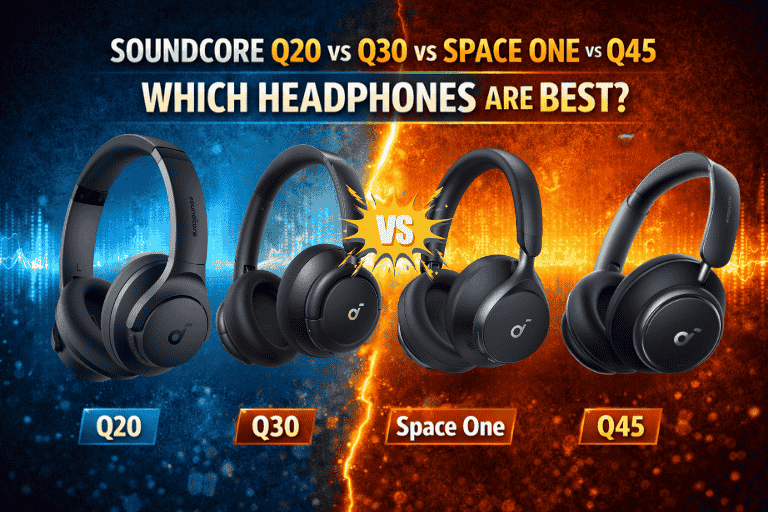
Anker's Soundcore brand has become the go-to choice for budget-conscious audiophiles who refuse to compromise on quality. Their lineup of over-ear noise-canceling headphones—the Q20, Q30, Q45, and the newer Space One—offers impressive features at prices that undercut Sony, Bose, and Apple by hundreds of dollars. But with four similar models ranging from $60 to $150, which one actually deserves your money?
The answer, frustratingly, is "it depends." Each model targets different priorities—maximum value, best sound, longest battery, or newest features. This guide cuts through the marketing speak to help you choose the right Soundcore headphones based on what you actually need, not what sounds impressive on a spec sheet.
The Lineup at a Glance
Soundcore Q20 ($60-80): The original budget champion, now often on sale for under $60. Basic but surprisingly capable.
Soundcore Q30 ($80-100): The sweet spot for most people—significantly better than Q20 without breaking the bank.
Soundcore Space One ($100-130): The newest model with refined design and improved noise cancellation, positioned between Q30 and Q45.
Soundcore Q45 ($130-150): The flagship with premium features, adaptive ANC, and LDAC support for audiophiles.
Design and Build Quality: Plastic Fantastic (Mostly)
Let's be honest—none of these headphones scream "premium." They're all plastic construction, though to varying degrees of refinement.
Q20: Functional, Not Beautiful
The Q20 looks and feels exactly like what it is—a budget headphone. The all-plastic construction feels sturdy enough but lacks any premium touches. The headband padding is adequate but thin. The ear cups are functional but not particularly comfortable for extended wear. The design is chunky and unmistakably budget-tier.
However, build quality is solid. Users report Q20s surviving years of daily use, backpack stuffing, and general abuse. They're not pretty, but they're built to last.
Q30: Refinement on a Budget
The Q30 represents a noticeable design upgrade. The headband has better padding, the ear cups use softer memory foam, and the overall aesthetic is more refined. The materials are still primarily plastic, but with a more premium finish that doesn't scream "cheap."
Comfort improves significantly over the Q20. The larger, softer ear cups and better headband padding make the Q30 comfortable for 3-4 hour sessions. The clamping force is moderate—tight enough to stay secure but not so tight that they cause headaches.
Space One: Modern Minimalism
The Space One marks Soundcore's move toward contemporary design. The aesthetic is cleaner, more minimalist, with a matte finish that looks more expensive than the price suggests. The ear cups are slightly slimmer than the Q30, giving a less bulky appearance.
Comfort is comparable to the Q30, though some users find the Space One slightly less spacious for larger ears. The headband padding is excellent, and the overall weight distribution feels balanced. The build quality feels marginally more solid than the Q30, though both are durable enough for daily use.
Q45: The Premium Contender
The Q45 represents Soundcore's attempt at a truly premium-feeling product. While still predominantly plastic, the materials and finish are noticeably higher quality. The aluminum accent pieces, though largely cosmetic, add visual interest. The overall aesthetic could almost pass for headphones twice the price.
Comfort is where the Q45 justifies its higher price. The ear cups use plush memory foam that remains comfortable even after 5-6 hours. The headband padding is generous, and the clamping force is perfectly balanced. These are legitimately comfortable headphones for all-day wear.
The hinge mechanisms feel more robust on the Q45, and the folding mechanism operates smoothly. Little touches—like the satisfying click of the power button and the quality feel of the ANC toggle—elevate the experience.
Winner: Q45 for comfort and premium feel, Q30 for best value-to-comfort ratio
Sound Quality: Where Differences Really Emerge
This is where things get interesting. Sound quality varies significantly across the lineup, and surprisingly, the most expensive isn't always the best for everyone.
Q20: Better Than Expected
The Q20 punches well above its price in sound quality. The signature is bass-heavy—these are definitely consumer-tuned headphones with emphasis on low-end thump. But unlike cheap headphones where bass drowns everything else, the Q20 maintains decent separation and clarity.
The mids are slightly recessed, which makes vocals sit behind instruments somewhat. Highs are rolled off, lacking the sparkle and detail of pricier headphones. The soundstage is narrow, as expected from closed-back budget headphones.
For the price, though? The Q20 sounds shockingly good. They handle hip-hop, EDM, and pop exceptionally well. Acoustic and classical music reveals their limitations more clearly, but for mainstream listening, they're impressive.
Q30: The Balanced Approach
The Q30 refines the Q20's sound signature with better balance across frequencies. Bass is still emphasized but more controlled, with better extension and less bloat. The mids come forward, making vocals clearer and more present. Highs gain detail and sparkle, though they still don't match truly premium headphones.
The soundstage opens up noticeably compared to the Q20. Instrument separation improves, making complex tracks easier to parse. The overall presentation is more mature and refined.
The Q30 introduces EQ presets in the Soundcore app, allowing customization. The "Signature" preset is well-balanced for general listening. "Bass Booster" satisfies bassheads without destroying the overall balance. Custom EQ allows fine-tuning to personal preference.
Space One: Refined and Neutral
The Space One shifts toward a more neutral, reference-oriented sound signature. Bass is still present but less emphasized than the Q30. Mids are clear and forward, making vocals shine. Highs are detailed without being harsh, representing a significant upgrade over previous models.
The soundstage is the widest in the lineup (excluding the Q45), creating a more spacious, less congested presentation. Detail retrieval is excellent for the price—you'll hear subtle elements in familiar tracks that the Q20 and Q30 miss.
For critical listening, classical music, jazz, and well-recorded acoustic music, the Space One outperforms the Q30. For bass-heavy genres, some users prefer the Q30's more aggressive low-end.
Q45: Flagship Performance
The Q45 delivers the most technically proficient sound in the lineup. LDAC codec support (Android only) enables high-resolution audio playback, though the difference is subtle with typical streaming quality.
The default tuning is relatively neutral with slight bass emphasis—think "studio reference with a fun tilt" rather than "consumer bass cannon." Bass is deep, controlled, and textured. Mids are clear and natural. Highs are detailed and extended without harshness.
The soundstage is the widest and most three-dimensional. Imaging is precise—you can pinpoint instrument locations in the stereo field. Detail retrieval is impressive, competing with headphones costing $200-300.
The Q45's adaptive EQ analyzes your hearing and adjusts the sound signature accordingly—a feature borrowed from premium brands. Whether this meaningfully improves sound is debatable, but it demonstrates Soundcore's ambition.
Winner: Q45 for audiophiles, Space One for balanced sound, Q30 for fun consumer tuning, Q20 for budget excellence
Active Noise Cancellation: How Much Silence Do You Need?
ANC performance varies dramatically across the lineup, and this might be the deciding factor for many buyers.
Q20: Basic But Functional
The Q20's ANC is rudimentary—single-mode, non-adaptive, and not particularly powerful. It handles constant low-frequency noise (airplane engines, bus rumble, AC hum) reasonably well. It does almost nothing for mid-to-high frequency sounds (voices, keyboard clacking, street noise).
For quiet environments or just blocking out gentle background noise, the Q20's ANC is adequate. For genuinely noisy environments—busy offices, public transport, flights—it's insufficient.
Q30: Multi-Mode Versatility
The Q30 introduces three ANC modes—Transport, Indoor, and Outdoor—each optimized for different noise profiles. The difference between modes is noticeable and genuinely useful.
Transport mode is the most aggressive, targeting low-frequency rumble. It's effective on buses, trains, and planes, though it doesn't match Sony or Bose flagships. Indoor mode balances noise reduction with natural sound for office environments. Outdoor mode reduces wind noise while maintaining awareness of surroundings.
The Q30's ANC represents a significant upgrade over the Q20. It won't make a busy subway completely silent, but it reduces background noise enough to make music enjoyable at reasonable volumes or podcasts easily understandable.
Space One: Refined and Adaptive
The Space One's ANC is noticeably more effective than the Q30's, with better high-frequency attenuation. Voices, keyboard noise, and other mid-range sounds that the Q30 struggles with are significantly reduced.
The adaptive ANC automatically adjusts based on environmental noise levels, though the implementation isn't as sophisticated as premium competitors. The Space One also includes a transparency mode that works well for quick conversations or environmental awareness.
For noise cancellation specifically, the Space One represents the sweet spot—significantly better than the Q30 without the premium price of the Q45.
Q45: Premium-Level Performance
The Q45's ANC competes with headphones costing twice as much. The adaptive system automatically adjusts to ambient noise in real-time, and the effectiveness is impressive. Low-frequency rumble virtually disappears. Mid-range noise is substantially reduced. Even high-frequency sounds are noticeably attenuated.
The Q45 won't quite match the best from Sony or Bose, but it gets remarkably close at a fraction of the price. For frequent travelers or those working in noisy environments, the Q45's ANC alone might justify the price premium.
The transparency mode on the Q45 is also the best in the lineup, providing natural-sounding environmental awareness without the artificial "robotic" quality of cheaper implementations.
Winner: Q45 for best ANC, Space One for best value in ANC, Q30 for versatile modes, Q20 for basic needs only
Battery Life: Marathon Performers
Battery life is where Soundcore headphones genuinely shine across the entire lineup.
Q20: 40 hours with ANC, 60 hours without Q30: 40 hours with ANC, 60 hours without
Space One: 40 hours with ANC, 55 hours without Q45: 50 hours with ANC, 65 hours without
These numbers are remarkable, especially compared to premium competitors offering 20-30 hours. The Q45's 50-hour ANC battery life is absurd—you could use them for a week of commuting without charging.
All models charge via USB-C and support fast charging (5 hours of playback from 5 minutes of charging on Q30, Space One, and Q45). None support wireless charging.
Winner: Q45 for longest life, but all models are excellent
Features and Connectivity: The App Makes the Difference
Soundcore App:
All models except the base Q20 integrate with the Soundcore app, which is well-designed and genuinely useful.
- Custom EQ (8-band graphic equalizer)
- EQ presets (Signature, Bass Booster, Treble Booster, Voice, Flat)
- ANC mode selection (Q30, Space One, Q45)
- Firmware updates
- Find your headphones feature
- Battery level indicator
- Sleep mode timer
The Q20 lacks app support entirely, relying on physical controls only. This limits customization but also simplifies the experience.
Codec Support:
- Q20: SBC only
- Q30: SBC, AAC (no LDAC despite some sources claiming otherwise)
- Space One: SBC, AAC, LDAC
- Q45: SBC, AAC, LDAC
LDAC support on the Space One and Q45 enables high-resolution audio on compatible Android devices. iPhone users are limited to AAC regardless of model.
Multipoint Connection:
- Q20: No
- Q30: No
- Space One: Yes (two devices simultaneously)
- Q45: Yes (two devices simultaneously)
Multipoint connectivity allows seamless switching between devices (laptop and phone, for instance) without manual re-pairing. This is incredibly convenient if you regularly use headphones with multiple devices.
Physical Controls:
All models use physical buttons rather than touch controls. This is actually preferable—buttons work reliably even with gloves, don't trigger accidentally, and provide tactile feedback. The button layout is intuitive across all models.
Winner: Q45 for complete feature set, Space One for best features-to-price ratio
The Verdict: Which Should You Buy?
Buy the Q20 if:
- Budget is absolutely paramount ($60 or less)
- You want basic ANC and good sound without complexity
- You don't need an app or advanced features
- You're buying for a teenager or as a backup pair
Buy the Q30 if:
- You want the best overall value (typically $80)
- You prioritize fun, bass-forward sound
- You want multiple ANC modes
- You value comfort but don't need absolute best-in-class
- You're an iPhone user (LDAC doesn't benefit you anyway)
Buy the Space One if:
- You want more neutral, reference-oriented sound
- You value modern aesthetics and design
- You need strong ANC but not quite flagship-level
- You want LDAC support on Android
- Multipoint connectivity is important
- You're willing to spend $100-130 for refinement over Q30
Buy the Q45 if:
- You want the absolute best Soundcore offers
- ANC performance is a top priority
- Comfort for extended wear matters
- You're an Android user who values LDAC
- You need exceptional battery life (50+ hours)
- You want headphones that compete with $250-300 models
The Real-World Recommendation
For most people, the Q30 remains the sweet spot. At around $80, it delivers 80% of the Q45's performance at half the price. The sound is enjoyable, ANC is effective enough for most situations, comfort is good, and battery life is excellent.
The Space One is the choice for those wanting more refinement—better sound, stronger ANC, modern design, and multipoint connectivity—without jumping to the Q45's price.
The Q45 is for enthusiasts who want genuinely premium performance without premium pricing. If you're comparing against Sony XM5s or Bose QC45s, the Q45 saves you $200 while delivering 85-90% of the performance.
The Q20 has become a tough sell unless you're on an extreme budget. The Q30 frequently goes on sale for $60-70, making it a better buy than the Q20 even at small price differences.
What About Alternatives?
At these price points, Soundcore's main competition comes from:
Sony WH-CH720N ($100-150): Better ANC and sound than Q30, not quite Q45 level. Sony app is excellent. Less battery life.
Sennheiser HD 450BT ($100-150): Superior sound quality, weaker ANC than Q30/Space One. For music purists over ANC fans.
JBL Live 660NC ($80-130): Comparable to Q30, slightly better bass, weaker ANC. JBL sound signature (fun and energetic).
Against these, Soundcore holds its own through exceptional battery life, solid all-around performance, and frequent sales bringing prices lower.
The Bottom Line
Soundcore has mastered the budget-to-midrange headphone market by delivering features and performance that punch well above their price class. You won't get the absolute best ANC, the most premium materials, or the most refined sound—but you'll get remarkably close while saving hundreds of dollars.
The Q30 remains the default recommendation for most buyers. The Space One is the refined upgrade for those wanting more. The Q45 is the flagship that competes with the big names. And the Q20, while still functional, has been largely superseded by the Q30's frequent sales.
Whichever you choose, you're getting headphones that would have cost twice as much just a few years ago. That's the real story here—Soundcore has democratized good audio, making quality noise-canceling headphones accessible to anyone, not just those willing to spend $300+.
Your ears—and your wallet—will thank you.
